Coquette Bow Cowgirl Boots
First Impression: Sweet Western Charm, Not Just Another Cowboy Cliché
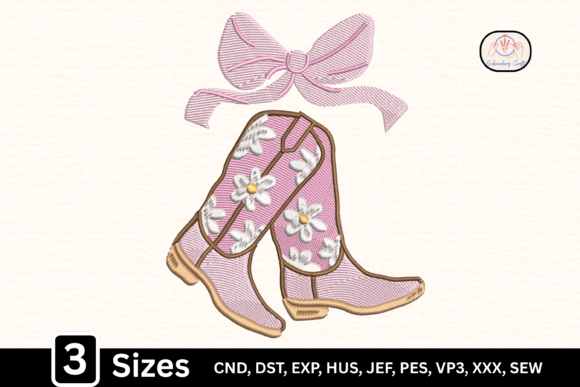
As an embroidery designer who’s prepped over 200 craft fair booths—and watched which designs stop shoppers mid-aisle—I’ll say it plainly: Coquette Bow Cowgirl Boots lands with soft confidence. It’s not loud or cartoonish. It’s not dusty ranch realism or stiff formal westernwear. It’s feminine, floral, and quietly intentional—a design that leans into “coquette” as charm, not costume. The pink western floral motif signals approachability; the bow adds playful polish. Customers don’t see “cowboy boots”—they see personality. That distinction is everything on a crowded handmade market table.
Where Coquette Bow Cowgirl Boots Shines (and Where It Fades)
This machine embroidery design thrives where handmade warmth meets curated style. On a tote bag design, placed just below the handle seam, it reads instantly—sweet but substantial. As apron embroidery centered above the pocket? Perfect. It balances utility and whimsy without overwhelming the wearer. For tea towel embroidery, use it small (2.5" wide) in one corner—it lifts the whole piece from functional to giftable.
It’s also a standout embroidered patch: clean lines, clear silhouette, and enough detail to feel special without being fussy. Stitched onto denim pouches or canvas market bags, it elevates a simple item into a boutique-ready product. And on pillow covers? Yes—especially blush, ivory, or sage linen. The floral elements soften against natural fibers, making the design feel like part of the fabric, not pasted on.
But be selective. Avoid using Coquette Bow Cowgirl Boots on curved cap surfaces unless you’ve tested it on your specific hat blank—the bow’s symmetry can distort. Skip dense-textured tea towels unless you double-stabilize; the fine petals may blur. And while it photographs beautifully for Etsy seller listings (soft lighting + neutral background), it loses impact on dark fabric unless thread colors are high-contrast—think rose gold or cream on charcoal, not pale pink.
Production Reality Check: Clarity, Consistency, and Commercial Readiness
At a glance, Coquette Bow Cowgirl Boots is intuitive—no decoding needed. A shopper sees “bow,” “boots,” “floral,” and “pink” in under two seconds. That speed matters when buyers scan 30+ booths in under five minutes. It works equally well as a small accent (1.75" on a keychain pouch) or a large focal design (4.5" on a tote front), though I recommend staying between 2.25"–3.75" for most handmade product applications.
For batch production? It’s highly repeatable. No tiny lettering to misalign, no micro-details that vanish at scale. The stitch density feels balanced—not so light it looks cheap, not so heavy it gums up lightweight cotton. That said, always test the design on scrap fabric first. Check how the bow loops hold on quilting cotton versus twill. Confirm spacing between floral stems doesn’t crowd on tapered surfaces like apron straps. And verify your hoop size matches the file’s native dimensions—don’t force-fit a 5x7 design into a 4x4 hoop and lose definition.
Careful-Use Notes Every Designer Should Heed
- Dense stitch areas: The bow center and boot toe florals carry moderate density—use medium-weight cutaway stabilizer on knits or stretchy fabrics.
- Tiny details: Petal edges are crisp but not fragile—still, avoid sub-1.5" scaling on textured towels or terry cloth.
- Curved surfaces: Caps and curved pouches require re-hooping or specialty hoops. Test before committing to 50 units.
- Dark fabric: Pink thread may mute. Swap to ecru, lavender, or peach for visibility—then update your printable mockup accordingly.
- Fabric texture: On heavy linen or burlap, reduce top thread tension slightly to prevent puckering around stem lines.
Booth Impact & Buyer Engagement: Why This Design Moves Units
In person, Coquette Bow Cowgirl Boots draws women aged 28–55—the core of craft fair foot traffic. It sparks conversation (“Is that custom?” “Where’d you get those boots?”), which means longer dwell time and higher conversion. Paired with matching pink gingham ribbon or dried lavender sachets on your display, it strengthens brand consistency across your small shop product line.
Visually, it adds handmade quality cues: balanced fill, smooth satin stitch transitions, thoughtful negative space. That perception of care translates directly to perceived value—customers pay more for items that look intentionally designed, not mass-printed. And because it sits comfortably between “country” and “contemporary,” it broadens your appeal beyond strict western boutiques into general gift shops and lifestyle markets.
Final Designer Checklist Before You Cut Thread
- Run a test stitch on your target fabric + stabilizer combo.
- Check thread contrast under both daylight and booth lighting.
- Review spacing between boot shaft and bow—if too tight, adjust digitizing software before bulk stitching.
- Confirm commercial licensing is included with your digital embroidery file. If selling finished products, this isn’t optional.
- Create at least one real-world finished product mockup—not just digital. Hold it. Drape it. See how light hits the petals.
- Compare how the design reads on three fabric colors: light, medium, and dark. Adjust thread palettes per variant.
Bottom line: Coquette Bow Cowgirl Boots isn’t just another cowboy motif—it’s a quiet differentiator. In a sea of cacti and horseshoes, it offers charm with craftsmanship. When stitched right, displayed thoughtfully, and paired with cohesive design assets, it turns a simple tote bag into a story—and that’s what sells at craft fairs, on Etsy, and in every heartfelt handmade exchange.