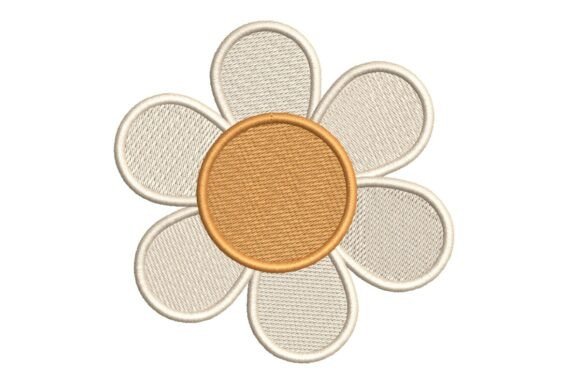
Simple Daisy Flower Embroidery Design
A Thoughtful Review for Small Business Merchandise & Branded Patches
As an embroidery designer who’s helped over 200 small businesses translate their brand into stitched form—from neighborhood bakeries to indie florists and handmade pet accessory lines—I approached the Simple Daisy Flower Embroidery Design with both curiosity and practical scrutiny. This isn’t just another floral motif. It’s a deliberate, minimal gesture: six textured light beige or off-white petals with a subtle outline, styled to evoke natural simplicity without sacrificing clarity or stitch integrity. For small business owners, apparel decorators, Etsy sellers, and craft-based brands, this design lands somewhere between handmade warmth and quiet professionalism—a rare balance in the Single Flowers category.
First Impression: Friendly, Timeless, and Brand-Ready
The Simple Daisy Flower Embroidery Design feels intentionally uncluttered—not generic, but generously adaptable. It reads as elegant on a linen apron, playful on a child-sized tote, and classic when stitched onto a café staff cap. There’s no heavy fill, no intricate center detail that risks filling in on low-density fabric—and that’s intentional. Its strength lies in restraint: the subtle outline provides definition without rigidity; the textured petals suggest tactility, not flatness. That makes it ideal for custom apparel where you want recognition at a glance, not deciphering.
Real-World Performance Across Business Applications
In practice, the Simple Daisy Flower Embroidery Design shines where many floral designs falter: consistency across varied substrates and uses.
- Embroidered patches: Holds shape beautifully at 2”–3” sizes. The open petal structure avoids excessive stitch density, reducing puckering risk on twill or cotton patch backing.
- Staff uniforms & aprons: Works cleanly on left-chest placement—even on curved seams—thanks to its balanced symmetry and modest footprint. Ideal for boutiques, studios, and cafés wanting approachable yet polished identity.
- Cap embroidery: Performs well on front panels of structured caps when digitized with appropriate underlay and reduced density. Avoid placing it directly over high-curve areas like the crown seam without testing.
- Tote bag design & product packaging accents: Reads clearly at mid-scale (3.5”–4.5”) on canvas or jute. Its soft contrast works especially well against natural-fiber bags—no need for bold thread unless branding demands it.
- Handmade product labels & customer gifts: Stitches cleanly on tea towels, ceramic tags, and woven labels. Its gentle aesthetic supports artisanal positioning without competing with hand-lettered names or logos.
Where to Use It With Intention—Not Assumption
This design is versatile, but not universal. As a professional embroiderer, I advise caution in these scenarios:
- Sub-1.75” patches: Petal separation and texture may blur. Always test at final size—especially for iron-on or velcro-backed patches.
- Dark or heavily textured uniforms: Light beige/off-white thread can fade visually. Consider switching to ecru, oat, or heather gray thread—or adding a thin black outline (if your digitizer permits) for contrast.
- Frequent-wash items: While the stitch layout is stable, always pair with cutaway stabilizer on knits or lightweight fabrics to preserve petal definition over time.
- Curved surfaces like baseball caps or sleeves: Confirm hoop size compatibility and digitizing tension settings—some versions may require slight petal spacing adjustment for optimal drape.
- Commercial embroidery projects requiring scalability: Verify that the digital embroidery file includes multiple sizes (e.g., 2”, 3”, and 4”)—not just one fixed dimension.
How It Strengthens Brand Identity & Customer Trust
For small businesses, visual consistency isn’t about repetition—it’s about resonance. The Simple Daisy Flower Embroidery Design reinforces brand identity by acting as a quiet signature: recognizable, repeatable, and emotionally coherent. A florist uses it on staff aprons and gift tags; a pet brand places it beside paw-print icons on collars; a bakery stitches it onto reusable pastry bags. In each case, it signals care, authenticity, and attention to detail—traits customers associate with handmade product integrity.
That perception translates directly to trust. When a customer sees the same thoughtfully stitched daisy across merchandise, packaging, and team wear, they subconsciously register cohesion and intention. No flashy fonts or complex graphics needed—just consistent, well-executed execution. That consistency also simplifies design assets management: one clean motif scales across digital mockups, printed hang tags, and physical embroidery without visual fatigue.
Practical Designer Notes Before You Stitch
Before launching into production, here’s what every embroidery shop, small business owner, or digital file buyer should do:
- Test the machine embroidery design in black and white first—this reveals contrast issues and spacing inconsistencies invisible in color previews.
- Check how it renders at your smallest intended patch size—does each petal remain distinct? Does the outline hold?
- Review thread color options carefully. Light beige may disappear on cream fabric; consider matte cotton or rayon threads for softer texture.
- Inspect spacing between petals and outline—tight gaps can cause thread nesting on dense machines.
- Confirm hoop size compatibility. Some versions may require a 4x4 hoop minimum; others scale down to 3x3.
- Test on your actual fabric—especially if using textured linen, canvas, or performance blends. Adjust stabilizer type accordingly (cutaway for knits, tear-away for stable wovens).
- Create a printable mockup for client approval before stitching. Show it on cap, tote, and apron contexts.
- Compare the Simple Daisy Flower Embroidery Design beside your other logo elements—does it complement, not compete?
- Verify commercial licensing terms. Since this is intended for small business merch, ensure redistribution rights cover embroidered goods, patches, and resale items.
The Simple Daisy Flower Embroidery Design doesn’t shout—but it lingers. In a crowded marketplace where handmade product differentiation matters more than ever, sometimes the most powerful statement is a single, well-placed petal.