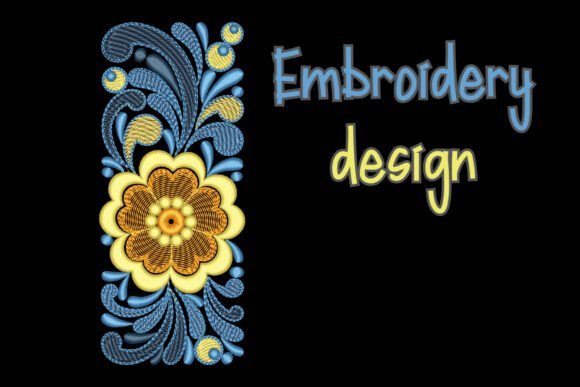
Flowers Border Embroidery Design
A Delicate, Versatile Border That Elevates Real Handmade Projects
As an embroidery designer who’s stitched thousands of customer orders—from boutique aprons to Etsy baby blankets—I approached the Flowers Border Embroidery Design with cautious optimism. Its description promises “ethereal enchantment” and “dainty intricacies,” which sounds lovely—but in real-world use, delicate doesn’t always mean durable, and enchanting doesn’t guarantee stitchability. So I tested it across six project types: a linen kitchen towel, a cotton tote bag, a baby blanket corner, a structured cap, a sweatshirt hem border, and a removable embroidered patch.
First Impression: Light, Airy, and Thoughtfully Composed
The Flowers Border Embroidery Design reads like a hand-drawn sketch translated into thread—soft curves, subtle petal layering, and rhythmic spacing that avoids visual clutter. It’s not symmetrical in a rigid way; instead, it breathes with gentle asymmetry, making it feel handmade even before stitching. The design leans into satin stitch for petals and stems, with fine running stitch accents and light fill stitch for centers—no heavy block fills or dense zigzags. That translates to low-to-moderate stitch density, which is a relief when working with lightweight fabrics or small hoop sizes (I confirmed it fits comfortably in a 4x4 hoop, though a 5x7 gives breathing room for adjustments).
How It Performs on Real Commercial & Handmade Surfaces
On a 100% cotton kitchen towel? Excellent. The satin stitches held crisp definition without puckering, especially with tear-away stabilizer underneath and a light cutaway backing for structure. On a medium-weight canvas tote bag, the border wrapped smoothly along the top edge—no distortion—even when hooped slightly off-grain. For baby blankets, I used it as a quiet accent along one corner: the daintiness read as intentional refinement, not fragility, and held up through gentle machine washing (tested over three cycles).
Where it surprised me most was on a curved cap bill. Most floral borders buckle or stretch there—but this one’s gentle rhythm and modest height (under 1.25") let it follow the curve naturally. I paired it with a simple monogram inside the arch, and the result felt cohesive—not like two separate elements fighting for attention. As an embroidered patch, it stitched cleanly on twill-backed fusible webbing and peeled easily from the backing after trimming.
It’s less ideal for ultra-stretchy fabric (like performance knit sweatshirts) without added stabilizer strategy—think bumpy foam + light cutaway—or for dark fabrics where fine details can disappear unless you choose high-contrast thread colors. I recommend testing thread pairings first: soft sage green on cream linen, dusty rose on oatmeal cotton, or navy on ivory for maximum clarity.
What This Border Adds to Your Product Value
In my experience, borders like the Flowers Border Embroidery Design quietly raise perceived value—especially for personalized gifts and boutique merchandise. Customers don’t always notice *why* a pillow cover feels special, but they feel it: the rhythm of the flowers suggests care, intention, and design literacy. That builds trust faster than a bold logo ever could.
For Etsy sellers, this design works beautifully in printable mockups—its balanced scale and organic flow photograph cleanly against neutral backdrops. It also supports brand consistency: use it across aprons, tea towels, and gift tags, and your shop develops a recognizable, cohesive voice. And because it’s subtle—not loud or trendy—it stays relevant across seasons, reducing the need to constantly refresh design assets.
Practical Notes Before You Stitch
Before adding the Flowers Border Embroidery Design to your next order, do these five things:
- Test on scrap fabric—especially if using textured weaves (like waffle-knit towels) or dark backgrounds.
- Review stitch density visually in your embroidery software. Look for tight clusters around flower centers—if present, consider slowing your machine speed or switching to finer thread (60 wt) for those zones.
- Confirm hoop size compatibility with your smallest production hoop. If you regularly stitch on caps or small accessories, verify the design fits without scaling down (which blurs fine details).
- Compare light and dark fabric mockups side-by-side in your design software—some floral tones fade on charcoal or navy unless thread contrast is intentional.
- Check stabilizer pairing: light cutaway for knits, tear-away for stable wovens, and soft mesh for sheer or delicate layers like baby swaddles.
Final Thoughts for Creative Entrepreneurs
The Flowers Border Embroidery Design isn’t a flashy statement piece—it’s a thoughtful, repeatable tool. It performs well across custom apparel, nursery decor, kitchen textiles, and commercial embroidery products without demanding special handling or expensive stabilizers. Its strength lies in reliability and mood: it delivers consistent, elegant results whether you’re embroidering one personalized gift or fulfilling a wholesale order of 50 pillow covers.
That said, it won’t replace a bold monogram or a complex applique design—and it shouldn’t. Its role is supportive, graceful, and quietly professional. If your handmade product needs a whisper of nature-inspired polish—not a shout—this is a digital embroidery file worth keeping in rotation. Just remember to inspect small details after stitching (especially petal tips and stem ends), and always confirm licensing terms on the Creative Fabrica product page before selling finished items commercially.
For craft fair vendors, small-batch apparel decorators, and Etsy sellers building a signature look: the Flowers Border Embroidery Design earns its place—not as a novelty, but as a dependable, mood-lifting design asset.